
California Foreclosure Timeline: What Happens After Missing Mortgage Payments?
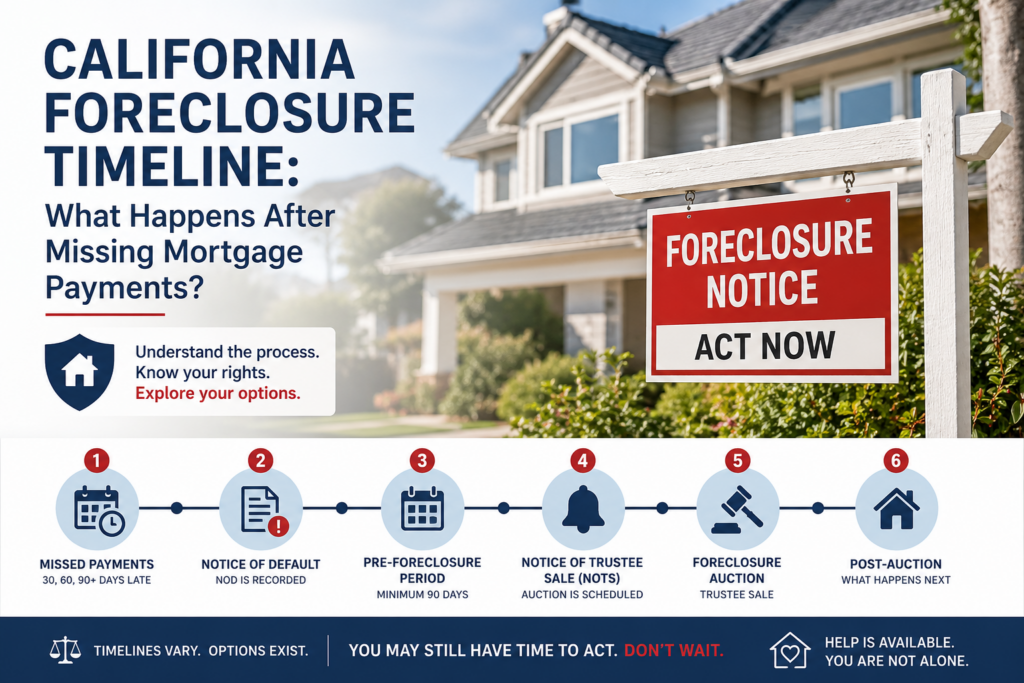
If you’ve fallen behind on mortgage payments or recently received a Notice of Default, you may be feeling overwhelmed, stressed, or unsure of what happens next. The good news is that foreclosure in California does not happen overnight. In many situations, homeowners still have time to understand their options and decide what path makes the most sense before foreclosure moves forward.
Many California homeowners assume that once they miss payments or receive foreclosure paperwork, it is already too late. That is often not true. Depending on where you are in the process, there may still be opportunities to catch up on payments, negotiate with your lender, refinance, seek assistance, or potentially sell your house before foreclosure auction.
Understanding the timeline matters because every stage of foreclosure comes with different deadlines, different rights, and different opportunities.
This guide explains the California foreclosure timeline step by step, including:
- What happens after missed mortgage payments
- What a Notice of Default (NOD) means
- When a Notice of Trustee Sale is issued
- How long foreclosure typically takes in California
- What happens at foreclosure auction
- Whether you can still sell your house before foreclosure
- Ways homeowners try to stop foreclosure
Whether you live in San Francisco, Oakland, Hayward, San Jose, Fremont, Vallejo, Richmond, Concord, or anywhere else in California, understanding the foreclosure process can help you make a more informed decision about what comes next.
What Is Foreclosure in California?
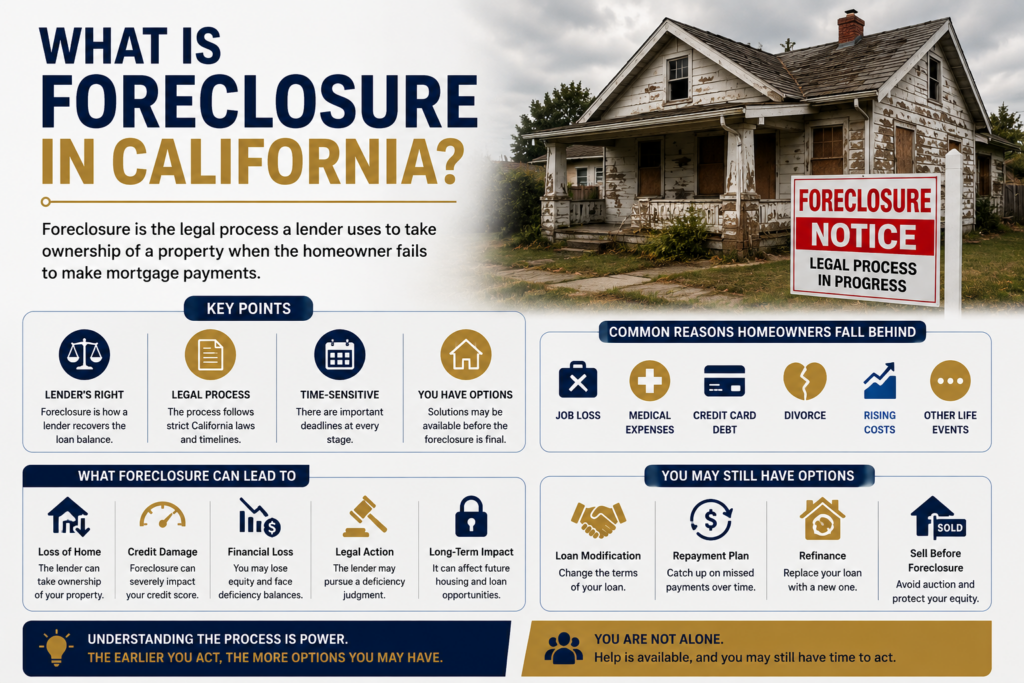
Foreclosure is the legal process lenders use to recover a property when mortgage payments have not been made according to the loan agreement.
In California, most foreclosures are nonjudicial foreclosures, meaning the lender typically does not have to go through a lengthy court process to foreclose on a home. Instead, the lender follows a series of legally required notices and waiting periods before scheduling a foreclosure auction, also called a trustee sale.
This process usually begins after several missed mortgage payments and follows a timeline that includes:
- Missed mortgage payments
- Late notices and lender outreach
- Notice of Default (NOD)
- Pre-foreclosure waiting period
- Notice of Trustee Sale (NOTS)
- Foreclosure auction
The exact timeline varies depending on the lender, loan type, and homeowner circumstances, but many California foreclosures take several months or longer, meaning homeowners often still have time to act.
One important thing to understand:
Receiving foreclosure paperwork does not automatically mean you lose your house immediately.
Many homeowners still have time to explore solutions before auction, including the possibility of selling the property before foreclosure moves forward.
Step 1: Missed Mortgage Payments (30–90 Days Late)
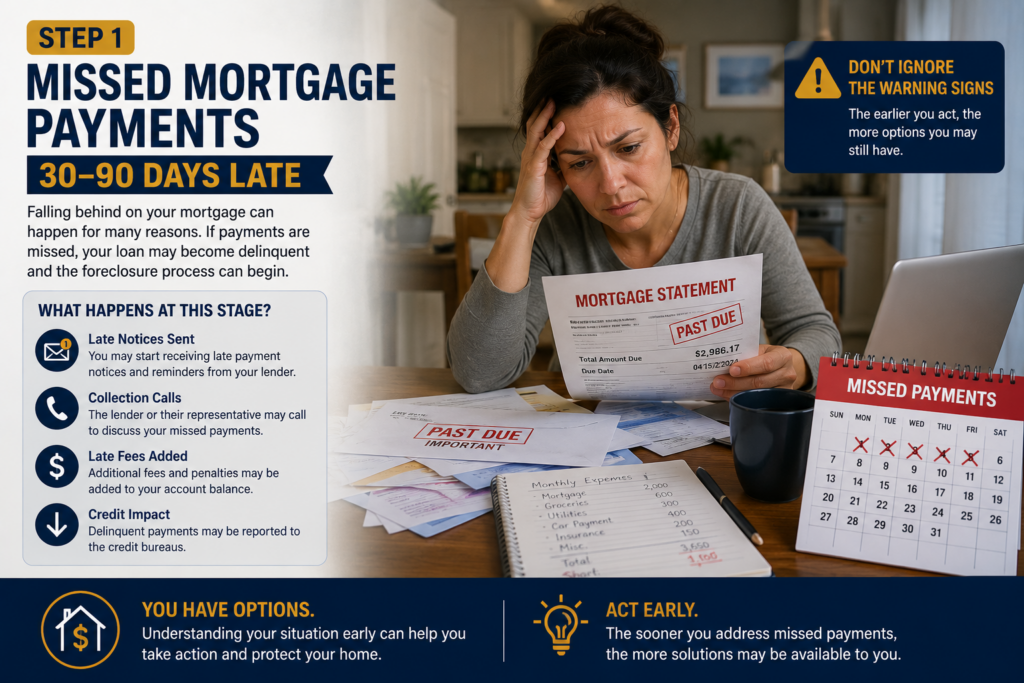
The foreclosure process generally begins after homeowners miss mortgage payments.
30 Days Late
After one missed payment, lenders typically begin reaching out with reminders and notices. At this stage:
- Late fees may begin accumulating
- Collection calls or letters may start
- Credit score impact may begin
Missing one payment does not automatically trigger foreclosure, but ignoring the issue can allow the problem to grow quickly.
Some homeowners fall behind because of:
- Job loss or reduced income
- Medical bills
- Divorce or separation
- Rising expenses
- Property tax increases
- Insurance costs
- Death in the family
- Unexpected life events
60 Days Late
By the second missed payment, lender communication often increases.
Homeowners may begin receiving:
- Stronger delinquency notices
- Mortgage collection outreach
- Warnings about default risk
At this stage, many homeowners start asking:
Can I still stop foreclosure?
In many situations:
Yes.
But timelines matter.
90 Days Late
After around 90 days of missed payments, lenders may begin preparing formal foreclosure proceedings.
For many homeowners, this is the point where financial stress becomes overwhelming.
Some people consider:
- Loan modification
- Reinstatement
- Selling the home
- Refinancing
- Family assistance
- Payment arrangements
Others simply feel frozen because they are unsure what to do next.
The important thing to understand is:
Ignoring the problem usually makes foreclosure harder to stop.
The earlier homeowners understand their timeline, the more potential options may still exist.
Step 2: Notice of Default (NOD)
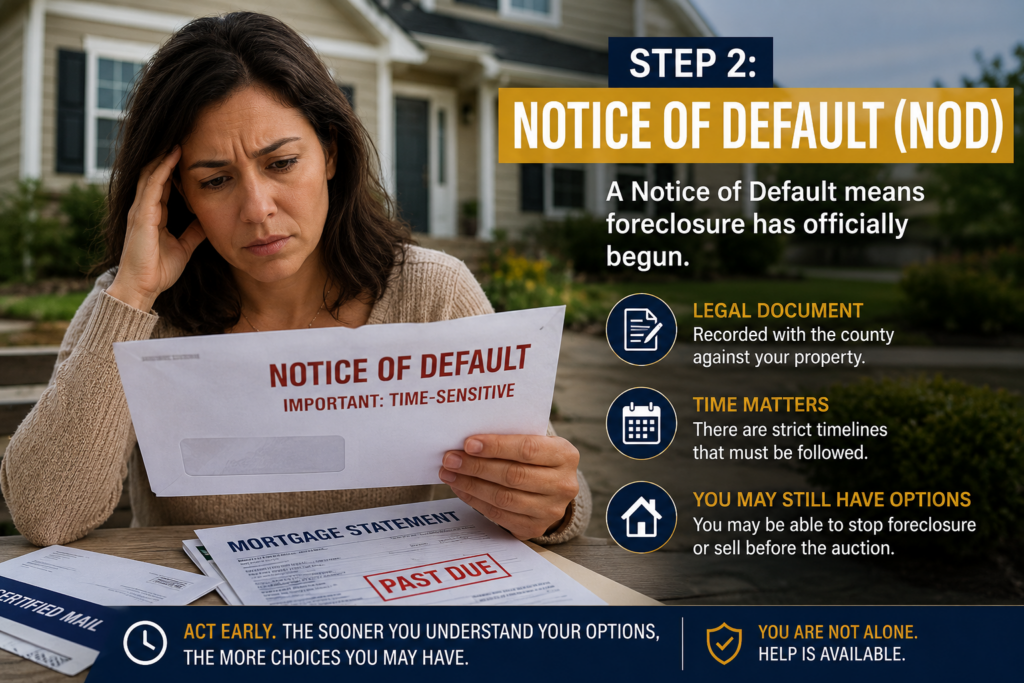
One of the most important stages in California foreclosure is the Notice of Default, commonly called an NOD.
A Notice of Default is a legal document recorded against the property that formally begins the foreclosure process.
If you receive a Notice of Default:
You are officially in pre-foreclosure.
For many homeowners, this is the moment when foreclosure suddenly becomes real.
The document generally outlines:
- The amount behind on payments
- Default details
- Loan information
- Steps needed to cure the default
Receiving an NOD can feel frightening, but it is important to understand something critical:
A Notice of Default does not mean foreclosure auction happens immediately.
In California, homeowners typically still have time after an NOD is recorded.
What Happens After a Notice of Default?
After an NOD is filed, California law generally requires a waiting period before the lender can move forward to the next stage.
During this period, homeowners often explore options such as:
Reinstating the Loan
Paying missed amounts to bring the mortgage current.
Loan Modification
Negotiating new mortgage terms with the lender.
Refinancing
Replacing the loan if financially possible.
Bankruptcy
Some homeowners use bankruptcy to temporarily pause foreclosure.
Selling Before Foreclosure
For homeowners who cannot realistically keep the property, selling the home before auction may sometimes allow them to:
- Avoid foreclosure on credit history
- Preserve remaining equity
- Avoid auction uncertainty
- Move on more privately
- Prevent additional stress
For example, a homeowner in Oakland, California or San Francisco, California who received a Notice of Default may still have time to sell the property before foreclosure auction depending on where they are in the timeline. While laws and lender timelines vary, the same general guidance applies to homeowners throughout California.
Many homeowners search:
“Can I sell my house after a Notice of Default?”
In many situations:
Yes — homeowners may still be able to sell after an NOD is recorded.
The key factor is:
time.
Waiting too long can reduce flexibility.
How Long After a Notice of Default Before Foreclosure?
In California, there is generally a required waiting period after a Notice of Default before the lender can issue a Notice of Trustee Sale.
This waiting period often gives homeowners time to:
- Understand the foreclosure timeline
- Explore solutions
- Speak with professionals
- Consider selling before auction
However, every lender and situation is different.
That is why many homeowners choose to understand their options as early as possible instead of waiting until deadlines become urgent.
You May Still Have Options Before Foreclosure Moves Forward
If you’ve received a Notice of Default, fallen behind on payments, or are worried about foreclosure auction, understanding your timeline is one of the most important things you can do.
Some homeowners ultimately keep the property.
Others decide that selling before foreclosure makes more sense financially, emotionally, or practically.
At Stop Bay Area Foreclosure, we help homeowners throughout the San Francisco Bay Area understand whether selling before foreclosure could make sense for their situation. We buy houses in pre-foreclosure and foreclosure as-is, helping homeowners avoid repairs, showings, agent commissions, and added stress when timelines are tight.

"*" indicates required fields
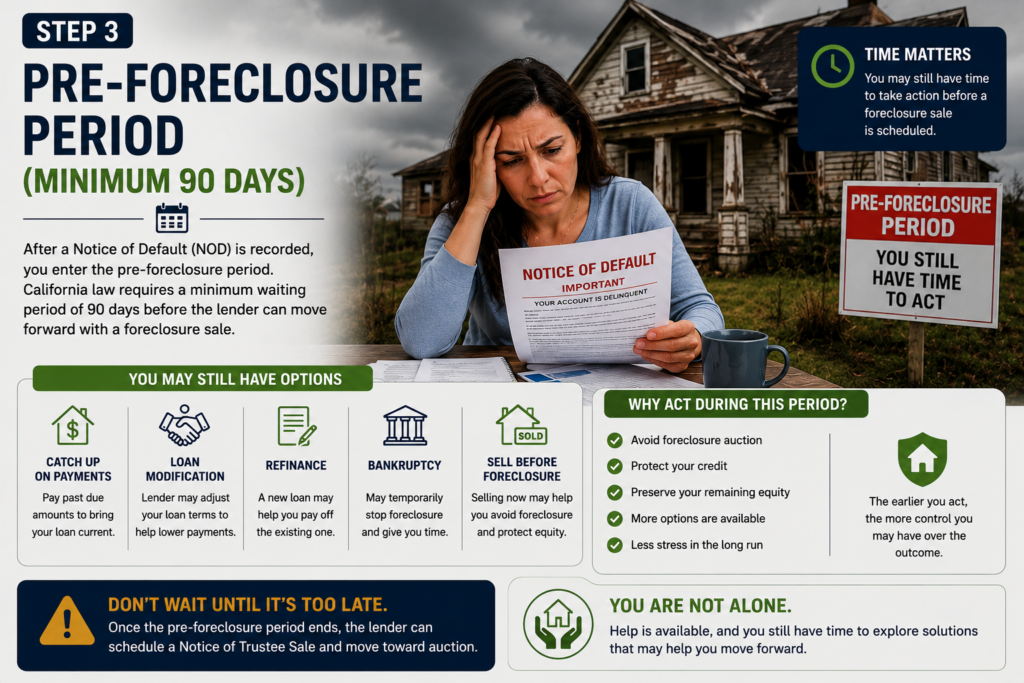
Step 3: Pre-Foreclosure Period (Minimum 90 Days)
After a Notice of Default (NOD) is recorded, California homeowners enter what is commonly called the pre-foreclosure period.
This stage is important because:
You may still have time to take action before foreclosure auction is scheduled.
For many homeowners, this period can feel stressful and uncertain. Mortgage payments may still be behind, lender communication may increase, and deadlines may begin to feel more serious. However, receiving a Notice of Default does not automatically mean you lose your house immediately.
In California, there is generally a required waiting period after a Notice of Default before a lender can move forward to the next stage of foreclosure.
During this time, homeowners often explore their options.
Common Options During Pre-Foreclosure
- Catch Up on Payments (Reinstatement)
Some homeowners are able to bring the mortgage current by paying missed amounts, fees, and penalties.
- Loan Modification
In some situations, lenders may adjust loan terms to help homeowners lower monthly payments or restructure the loan.
- Refinance
Depending on equity, credit, and financial circumstances, refinancing may sometimes be an option.
- Bankruptcy
Some homeowners explore bankruptcy to temporarily delay foreclosure and gain additional time.
- Sell the Property Before Foreclosure
For many homeowners facing financial hardship, selling before foreclosure may help avoid auction and preserve remaining equity.
For example, a homeowner in Oakland, California, San Francisco, California, or Hayward, California who is behind on payments may still have time to sell before trustee sale depending on the lender timeline. While every situation is different, the same general foreclosure process applies throughout California.
Why Acting Early Matters
One of the biggest mistakes homeowners make is:
Waiting too long.
Many people hope the situation improves on its own or avoid opening lender letters because the process feels overwhelming.
Unfortunately, delaying action often reduces available options.
The earlier homeowners understand their timeline, the more flexibility they may still have.
You May Still Have Time Before Auction
During pre-foreclosure, some homeowners ultimately keep their homes through reinstatement or loan assistance.
Others decide that selling the property before foreclosure moves forward makes the most financial sense.
If keeping the property is no longer realistic, selling before foreclosure may help homeowners:
- Avoid foreclosure on their record
- Preserve remaining equity
- Avoid auction uncertainty
- Eliminate repair concerns
- Move forward with less stress
At Stop Bay Area Foreclosure, we help homeowners throughout the San Francisco Bay Area explore whether selling before foreclosure may make sense for their situation. We buy houses in pre-foreclosure and foreclosure as-is, helping homeowners move quickly when timelines become urgent.
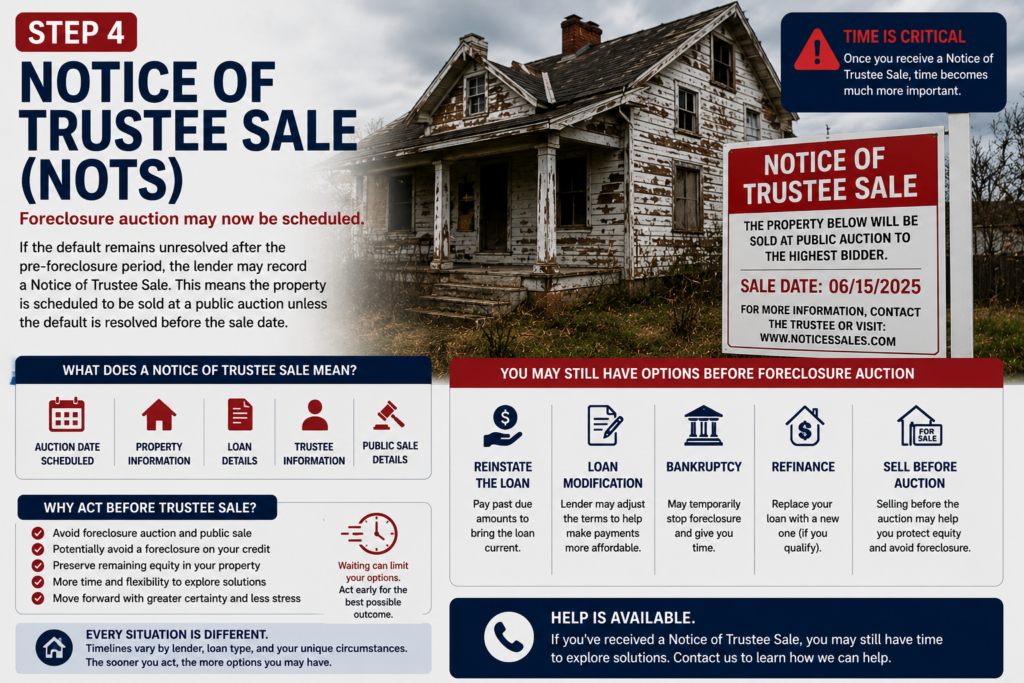
Step 4: Notice of Trustee Sale (NOTS)
If the mortgage remains unresolved after the pre-foreclosure period, the lender may move to the next major stage of foreclosure:
The Notice of Trustee Sale (NOTS)
This is one of the most serious foreclosure notices a homeowner can receive because it means:
A foreclosure auction date may now be approaching.
The Notice of Trustee Sale is a legal document that informs homeowners the lender intends to sell the property at a public auction unless the default is resolved before the scheduled sale date.
In California, the Notice of Trustee Sale is generally recorded and publicly posted, and homeowners are often given notice before auction moves forward.
For many homeowners, this is the stage where foreclosure suddenly feels urgent.
What Does a Notice of Trustee Sale Mean?
A Notice of Trustee Sale generally includes:
- The scheduled auction date
- Property details
- Loan information
- Trustee information
- Public sale details
At this stage, many homeowners ask:
“Is it too late to stop foreclosure?”
In many situations:
No — homeowners may still have options.
Depending on the timeline and lender circumstances, some homeowners still explore:
- Reinstating the loan
- Loan modification
- Bankruptcy
- Refinancing
- Selling the house before auction
However:
Time becomes much more important during this stage.
Waiting until the last minute can significantly reduce flexibility.
For example, a homeowner in San Francisco, California, Oakland, California, or Fremont, California who receives a Notice of Trustee Sale may still have time to sell before auction depending on where they are in the foreclosure timeline. While every lender and situation differs, homeowners throughout California often explore their options quickly at this stage.
Why Many Homeowners Choose to Act Before Auction
Once foreclosure auction approaches, uncertainty often increases.
Many homeowners feel pressure because they are unsure:
- If the house will sell at auction
- What happens after foreclosure
- Whether they will lose remaining equity
- How foreclosure may affect future housing or credit
This is why some homeowners choose to explore selling the property before foreclosure auction.
In certain situations, selling before auction may allow homeowners to:
- Avoid foreclosure appearing on credit history
- Preserve remaining equity in the property
- Avoid public foreclosure auction
- Eliminate repair or cleanup concerns
- Move on with greater certainty
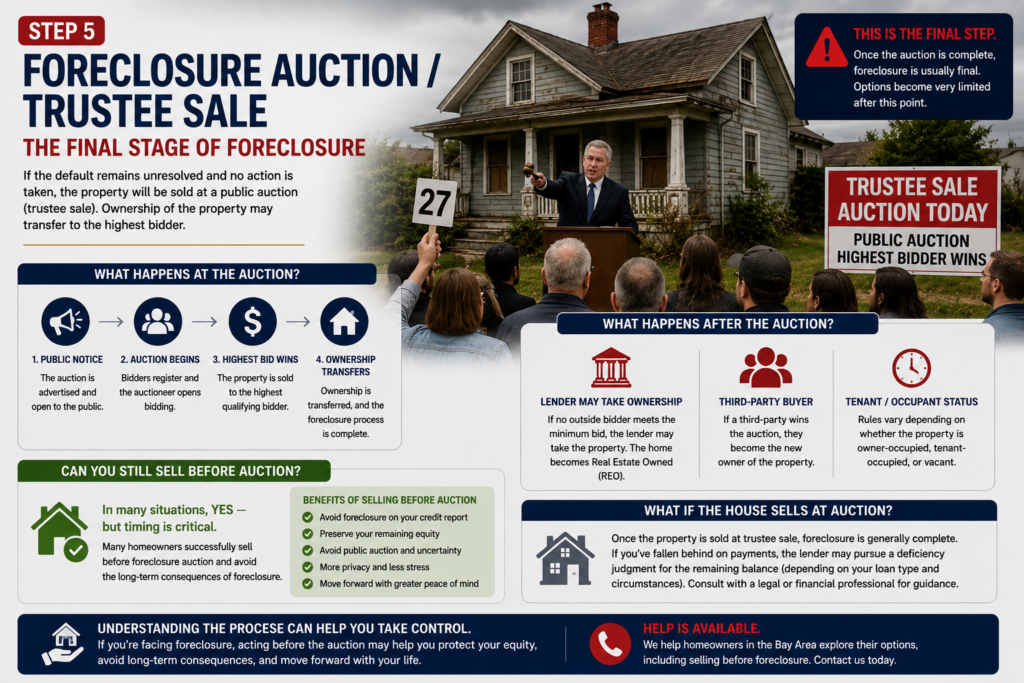
Step 5: Foreclosure Auction / Trustee Sale
If the mortgage default is not resolved and the property is not sold beforehand, the foreclosure process may move to:
Trustee Sale (Foreclosure Auction)
This is the stage where the property may be sold at a public auction.
In California, foreclosure auctions are often called:
Trustee Sales
During auction:
- The lender may bid on the property
- Third-party investors may bid
- The highest qualifying bid may win the property
At this point, ownership of the property can transfer.
For homeowners, this is usually the final stage of the foreclosure process.
What Happens at Foreclosure Auction?
Many homeowners imagine foreclosure auctions dramatically, but the reality is often much more procedural.
The property is typically:
- Announced publicly
- Auctioned to bidders
- Sold if bidding requirements are met
Sometimes:
The lender takes ownership
This can happen if no outside buyer bids enough.
The property may then become:
bank-owned (REO)
Can You Still Sell Before Auction?
One of the most common questions homeowners ask is:
“Can I still sell my house before foreclosure auction?”
In many situations:
Yes — but timing matters.
Many homeowners in California successfully sell their homes during pre-foreclosure before trustee sale occurs.
For homeowners who no longer believe keeping the property is realistic, selling before foreclosure may sometimes help:
- Protect remaining equity
- Avoid foreclosure consequences
- Avoid uncertainty at auction
- Create a more private transition
For example, a homeowner in Daly City, Berkeley, Emeryville, Livermore, or Vallejo who is approaching trustee sale may still explore selling before auction depending on lender deadlines. While every situation is unique, many California homeowners try to act before foreclosure becomes final.
What Happens If the House Sells at Auction?
Once a property is sold at trustee sale, the foreclosure process is generally complete.
The next steps vary depending on:
- Whether the lender purchased the property
- Whether a third-party buyer won the auction
- Occupancy status
- Property condition
For homeowners, options become much more limited after auction.
That is why many people try to understand the foreclosure timeline before reaching this stage.
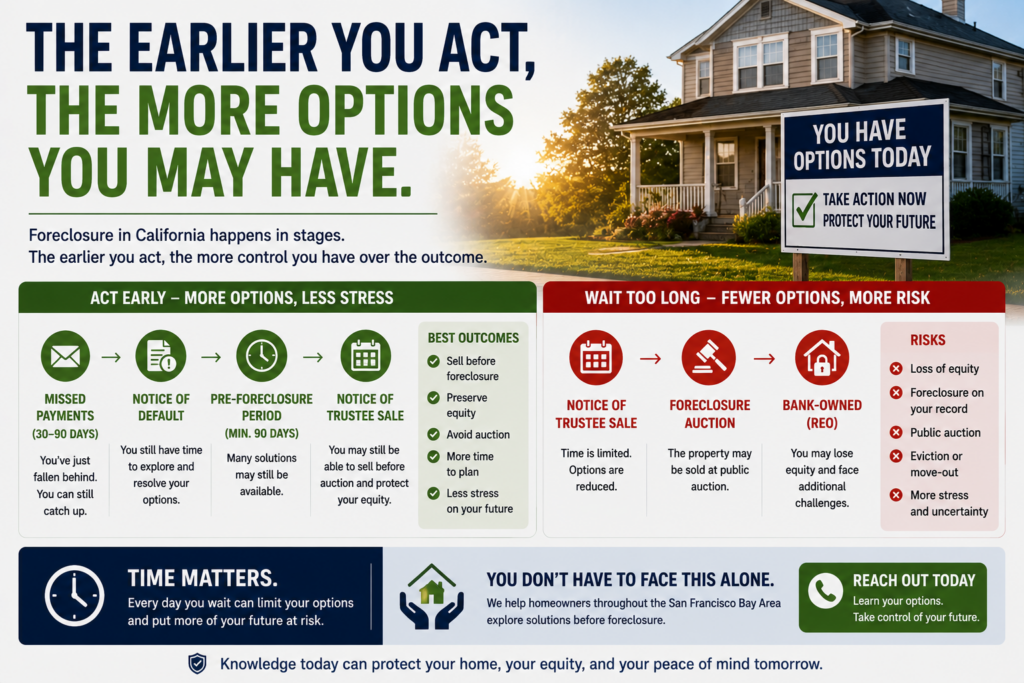
The Earlier You Act, The More Options You May Have
Many homeowners feel overwhelmed after receiving foreclosure notices.
That feeling is understandable.
But foreclosure in California usually happens in stages — meaning homeowners often still have time to understand their options before auction.
Some homeowners keep their homes.
Others decide selling before foreclosure is the better financial path.
The key is:
Understanding your timeline early.
At Stop Bay Area Foreclosure, we help homeowners throughout the San Francisco Bay Area explore whether selling before foreclosure may make sense for their situation. We buy houses in pre-foreclosure and foreclosure as-is, helping homeowners avoid repairs, showings, agent commissions, and unnecessary delays when timelines are tight.

Can You Stop Foreclosure in California?
One of the most common questions homeowners ask after falling behind on payments is:
“Can I stop foreclosure in California?”
The answer is:
Sometimes — but it depends on timing, finances, and your situation.
The earlier homeowners take action, the more potential options they may still have.
Foreclosure in California generally happens over time, which means many homeowners still have opportunities to act before foreclosure auction.
Below are some of the most common ways homeowners attempt to stop foreclosure.
1. Catch Up on Missed Payments (Reinstatement)
Some homeowners stop foreclosure by bringing the mortgage current.
This is often called:
Reinstatement
Reinstating a mortgage typically means paying:
- Missed payments
- Late fees
- Penalties
- Legal costs
For homeowners who recently experienced a temporary hardship — such as a job interruption, medical issue, or short-term financial setback — reinstatement may sometimes be possible.
However, for many homeowners, coming up with several months of payments at once may not be realistic.
2. Loan Modification
Some homeowners apply for:
Loan Modification
A loan modification changes the terms of the mortgage to potentially create more affordable payments.
Depending on the lender and financial situation, this could involve:
- Lower monthly payments
- Extended loan terms
- Adjusted interest rates
- Payment restructuring
Loan modifications can help some homeowners stay in their property.
However:
Not every homeowner qualifies.
And approval timelines can sometimes feel uncertain.
3. Refinance
For homeowners with strong credit or significant equity, refinancing may sometimes help stop foreclosure.
Refinancing means replacing the current mortgage with a new loan.
This option may be more realistic for homeowners who:
- Have strong income
- Have significant home equity
- Are only slightly behind
But for homeowners already deep into foreclosure, refinancing may become more difficult.
4. Bankruptcy
Some homeowners use bankruptcy to temporarily pause foreclosure.
Depending on the situation, bankruptcy may create:
an automatic stay
This can temporarily stop foreclosure activity.
Because bankruptcy is a legal matter, homeowners should speak with a qualified legal professional to understand risks, obligations, and whether it makes sense for their situation.
5. Sell the House Before Foreclosure
For many homeowners, especially those facing long-term financial hardship, selling before foreclosure may become the most realistic solution.
This is especially true when:
- Payments are no longer affordable
- Loan modification was denied
- Equity still exists in the property
- Home repairs are too expensive
- Life circumstances changed
Some homeowners initially feel embarrassed about selling.
Others wait because they hope things improve.
But many people eventually realize:
protecting remaining equity may be more important than waiting for foreclosure.
For example, a homeowner in San Francisco, California, Oakland, California, or Hayward, California who has received a Notice of Trustee Sale may still have time to sell depending on lender timelines. While every situation is different, homeowners throughout California often explore selling before foreclosure becomes final.

Can You Sell Your House Before Foreclosure in California?
Yes — in many situations, homeowners can still sell before foreclosure auction.
This is one of the biggest misconceptions about foreclosure.
Many homeowners believe:
“It’s already too late.”
Often:
It isn’t.
As long as foreclosure has not already completed, homeowners may still have the ability to sell.
The earlier homeowners act:
the more flexibility they often have.
Why Some Homeowners Choose to Sell Before Foreclosure
For some people, keeping the house no longer makes financial sense.
Maybe payments became too expensive.
Maybe medical bills, divorce, job loss, rising costs, or other life circumstances made the mortgage impossible to maintain.
Selling before foreclosure may sometimes help homeowners:
- Preserve Equity
If there is remaining equity in the property, homeowners may still be able to recover some of it instead of risking foreclosure auction.
- Avoid Foreclosure on Credit History
While every situation differs, selling before foreclosure may help some homeowners avoid a completed foreclosure appearing on their record.
- Avoid Repairs or Showings
Many homeowners facing financial hardship do not want to spend money fixing the property. Selling as-is may sometimes help avoid costly repairs.
- Avoid Agent Commissions
Some homeowners prefer a direct sale without listings, commissions, or months of uncertainty.
- Move Faster
When foreclosure deadlines are approaching, speed matters.
Protecting Your Equity Before Foreclosure
One of the biggest concerns many homeowners overlook is:
Equity loss.
If a property has equity and foreclosure moves forward, homeowners may lose opportunities they could have had by acting earlier.
This is one reason many homeowners begin exploring options once they receive:
- Collection notices
- Notice of Default
- Notice of Trustee Sale
Rather than waiting for auction.
For example, a homeowner in Fremont, San Francisco, Richmond, Oakland, San Jose, or Concord who still has equity may decide selling before foreclosure provides a cleaner financial outcome than waiting for auction. While outcomes vary by homeowner and lender, preserving equity is often a major reason people act earlier.
Every Situation Is Different
There is no single solution that works for everyone.
Some homeowners keep their property.
Some modify the loan.
Others refinance.
And some decide:
selling before foreclosure makes the most sense.
The important thing is understanding your options before deadlines become more urgent.
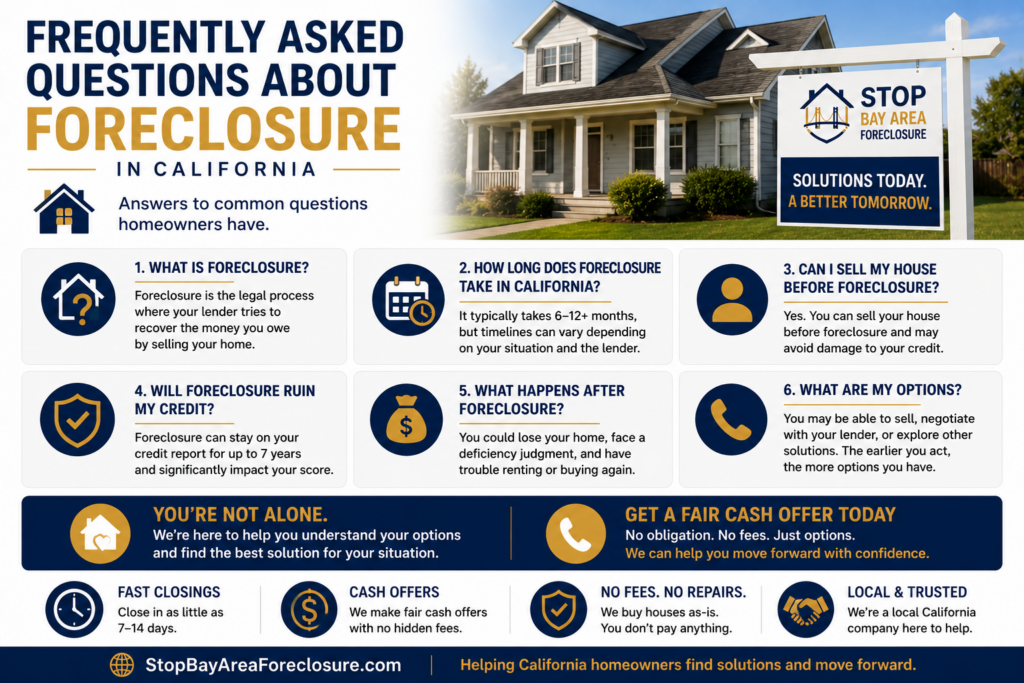
Frequently Asked Questions About Foreclosure in California
- How long does foreclosure take in California?
Every situation is different, but many California foreclosures take several months or longer. The timeline depends on lender actions, homeowner circumstances, and whether loss mitigation efforts are underway.
- What is a Notice of Default?
A Notice of Default (NOD) is a legal notice recorded against the property that officially begins the foreclosure process in California.
- Does a Notice of Default mean I already lost my house?
No. Receiving a Notice of Default does not automatically mean you lose your home immediately. Many homeowners still have time to explore solutions before foreclosure auction.
- Can I sell my house after receiving a Notice of Default?
Often, yes.
Many California homeowners successfully sell after receiving a Notice of Default and before trustee sale occurs.
- Can I sell my house before foreclosure auction?
In many situations:
Yes.
Timing matters, but homeowners can often still sell before auction if foreclosure has not already completed.
- What is pre-foreclosure?
Pre-foreclosure is the stage after a Notice of Default has been recorded but before foreclosure auction takes place.
- What is a trustee sale?
A trustee sale is the public foreclosure auction where the property may be sold.
- How many missed payments before foreclosure starts?
Many lenders begin foreclosure proceedings after multiple missed mortgage payments, often around 90 days delinquent, though timelines vary.
- Will foreclosure hurt my credit?
Foreclosure may negatively affect credit, though the impact varies depending on financial history and other circumstances.
- Can bankruptcy stop foreclosure?
In some situations, bankruptcy may temporarily pause foreclosure activity. Homeowners should speak with a qualified legal professional for advice.
- Can I stop foreclosure after receiving a Notice of Trustee Sale?
Sometimes. Options may still exist, but timelines become more urgent at this stage.
- What happens if my house sells at auction?
Ownership may transfer to a third-party buyer or lender depending on auction results.
- Can I keep my house during foreclosure?
Some homeowners are able to keep their property through reinstatement, modification, refinancing, or other financial solutions.
- Can I sell my house as-is before foreclosure?
Yes.
Many homeowners sell properties as-is before foreclosure without making repairs.
- Do I need to fix my house before selling?
Not necessarily. Some homeowners choose to sell their property in its current condition.
- What if I inherited a house facing foreclosure?
Inherited properties can still sometimes be sold before foreclosure depending on title and timeline.
- Can foreclosure happen without warning?
California foreclosure generally involves multiple notices and waiting periods.
- What is the difference between foreclosure and pre-foreclosure?
Pre-foreclosure occurs before auction. Foreclosure is typically complete once trustee sale happens.
- Is foreclosure public record?
Certain foreclosure filings and notices may become public record.
- Can I stop foreclosure one day before auction?
Sometimes homeowners still take action close to auction, but waiting reduces flexibility significantly.
- Should I wait and hope things improve?
Every situation is different, but waiting too long may reduce available options.

You May Still Have Time Before Foreclosure
If you are behind on mortgage payments, received a Notice of Default, or are worried about foreclosure auction, you may still have time to understand your options.
At Stop Bay Area Foreclosure, we help homeowners throughout the San Francisco Bay Area explore whether selling before foreclosure may make sense for their situation.
We buy houses in pre-foreclosure and foreclosure as-is, helping homeowners avoid repairs, showings, agent commissions, and added stress when timelines are tight.
If keeping the property is no longer realistic, we may be able to help you move forward with greater clarity and peace of mind.
Get An Offer Today, Sell In A Matter Of Days
"*" indicates required fields